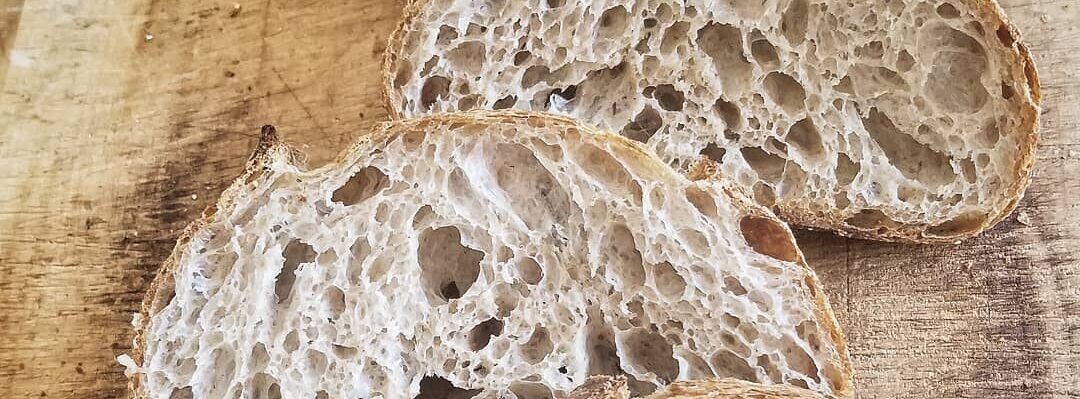

Since this challah recipe is a bit different than what you normally might find, I figured I’d just go ahead and explain the biggest difference right up front so that you know why I made certain choices that are maybe out of the norm. I’m not typically a fan of reinventing the wheel, so when I altar a classic in major ways I usually have a specific reason for doing so. I’ll explain some of the smaller differences as we go along, but I just want to get this “elephant in the room” out of the way first . . .
The main thing you need to understand is that I developed this recipe for a bakery I used to work at where I was mixing all the doughs by hand. These weren’t huge batches of dough, but I’d typically mix anywhere from 20lbs. to 40lbs. (9kg to 18kg) of dough per batch. I might have 6-10 different batches of dough I had to make on any given day, and a short window of time to get them all mixed before I needed to start benchwork (I was a one-man operation there, so I had to keep things moving quickly).
Typically, I would only mix the doughs until everything was evenly incorporated and the dough consistency homogenous. But I wasn’t developing the gluten whatsoever. I tried to get each batch mixed within about 15 minutes, and that includes all the weighing of ingredients, so each batch was only mixed for 10 minutes at most — usually less. Then I would dump the undeveloped dough into a bus tub for bulk and use coil folds to finish developing the dough (basically, after I finished mixing each batch I’d go around and coil fold every other batch that I had previously made, until they didn’t need any more folding).
When I was asked to come up with a challah recipe, my heart sank. Challah is generally a pretty stiff dough, and stiff dough was something I was trying to avoid because it was more difficult for me to mix by hand in such (relatively) large batches. However, having experimented with wetter challah dough in a different bakery back in my youth, I knew that soft challah dough doesn’t form very nice braids. The braids are too soft to hold a nice firm shape, and so they sort of just smooth out and blend together rather than making a nice bumpy shape with distinct braids. Basically, the challah ends up smooth and flattish without well-defined braids (just the lines that mark where the braids should have been). It’s hard to describe, but let’s just say it doesn’t make a pretty loaf.
Nevertheless, the thought of trying to hand-mix large batches of stiff challah dough was so terrifying that I decided to give soft challah dough a second chance. And having many more years experience under my belt than I had back when I suffered those early failures with soft challah dough, I had an idea . . .
With the benefit of hindsight, I realized that the problem back then wasn’t so much the soft dough itself, it was lack of sufficient dough structure necessary to hold up such a soft dough. So long as I could build enough dough structure, then using a soft dough should be fine. Fortunately, it was an easy fix. Back in the day, I only gave my soft challah dough about a 30% rise before we would toss it up on bench and start scaling it into pieces. I didn’t realize it back then, but that is not nearly enough of a rise to create sufficient structure for soft challah dough.
So what I decided to do was just let the dough at least double in volume during bulk (though tripling was preferred) and then I’d punch it down and let it double again before turning it out on bench. Simple! And this would also conveniently provide just enough time for the gluten — which was severely underdeveloped during the mix — to finish forming. The punch downs helped with that as well. So it was really a win-win. The tripling, and then doubling in volume creates a highly inflated dough with a surprisingly strong structure, even despite its soft dough consistency. And that’s how you can get well-formed and nicely defined braids from soft challah dough.

But there is one downside — even though the dough develops sufficient strength and structure to hold a nice form, it is still a very soft and enriched dough. And that means it’s sticky! This is not an easy dough to work with. Probably not the best recipe for newer bakers or first-time challah makers. You’ll notice in the video that I tend to use plenty of flour when I start benchwork (oh, and in case you didn’t know, benchwork is dividing, preshaping and shaping). So as a general recommendation, don’t be stingy with the flour when you’re doing your own benchwork. Don’t try to impress anyone with how little flour you can get away with. Trust me, it won’t be impressive when the dough is mercilessly sticking to your hands, scraper, bench or anything else that has the misfortune of coming into contact with it. Flour is your friend with this one.
Now that you know why I originally made this formula with such a soft dough consistency, let me explain why I’ve kept it that way. Afterall, if the original reason for soft dough was to make it easier to mix large batches, why do I still make the dough so soft now that I’m just making a couple loaves at a time?
Well, the answer is simple. I like the results!
And it’s not just me. This was one of the most raved about breads I made for that bakery. I was even once told by a self-described “challah connoisseur” that mine was the best she’d ever had. Now maybe she was just politely offering me a bit of flattery, but nevertheless, I like this formula as it is. I’m used to working with this dough so the challenge isn’t too great. For me, the results are well-worth dealing with the soft sticky dough. But for you? Only you can answer that.
Okay, so now that we’ve got all that out of the way, let’s get to business . . .
You can scale the formula to whatever amount of dough you need, but I published this recipe for two challah because that seemed wiser to me than just a single challah. Challah is devoured quickly in the household and is always popular as a gift to friends, family and neighbors. Plus, it freezes exceptionally well, and you’ll sleep better at night knowing that you have a spare challah in the freezer in case of an emergency.
Formula
- 100% All-Purpose or Bread Flour
- 32% Water
- 25% Egg Yolks
- 17% Honey
- 12% Oil (Corn/Veg/Olive)
- 2% Salt
- 1.5% Dry Yeast
Recipe (2 Loaves at ≈ 450g Each)
- 478g All-Purpose or Bread Flour
- 154g Warm Water
- 120g Egg Yolks (7 Yolks)
- 82g Honey
- 56g Oil (Corn/Veg/Olive)
- 10g Salt
- 7g Dry Yeast (1 Pkg.)
Mixing
Dissolve the yeast and salt into the warm water. Next, separate your egg yolks, then add the honey and oil and beat them well. Save the whites for whatever you might use them for (I usually just add them to scrambled eggs for a little extra protein). Once the egg mixture is well-beaten add it to the water mixture and mix it well.
IMPORTANT: Make sure the yeast is fully dissolved before you add the egg mixture. If undissolved yeast granules get coated by the egg and oil they can be very difficult to dissolve. I’ve made this mistake with a 25lb. batch of challah, and I cannot emphasize enough the gravity of that error. That was almost 10 years ago and I’m still recovering from the horror of that day.
Now, before we get to the flour, let me just explain a couple of the ingredient choices here. First of all, I chose to use just egg yolks rather than whole eggs, even though whole eggs seems to be more common. I did this because it gives the dough a deeper yellow color, a richer flavor, and a more moist and tender crumb. Obviously, it takes a lot more work to separate the egg yolks — especially when working with large batches where I had to separate multiple flats of 30 eggs at a time. And in a production setting, I typically prefer to err on the side of efficiency, even if it comes at a small cost to quality. But to me the difference was worth the extra effort.

You could also use frozen sugared egg yolks when working with large batches — and I would have if the batches got much bigger than they were — but you’ll have to lower the percentage of honey. And personally, I don’t think the sugared egg yolks provide as good a flavor as the straight egg yolks and honey. We used sugared egg yolks at the bakery where I had previously first experimented (and failed) with mixing soft challah dough, and to me the results just aren’t as good. Of course, the batch sizes there could be hundreds of pounds of dough at a time, so the frozen yolks were the only practical option.
As for the oil, I leave it up to you to use whatever oil you prefer. I’ve seen lots of recipes that call for olive oil, and I’m sure that was the traditional choice back in the day, but personally I prefer corn oil. I like its deeper yellow color, and it has a bolder taste that I think adds more depth of flavor to the challah. But again, use whatever you want . . . or whatever you have. Unfortunately, I didn’t have any corn oil on hand when I filmed this video, so I just used vegetable oil. It was fine.
Okay, now you can add the flour to the water and egg mixture. I prefer to use all-purpose flour because it emphasizes the tenderness of the crumb, but bread flour is perfectly acceptable. Bread flour will give you a slightly stiffer dough consistency (and the dough will be much easier to handle, as well) with the potential for greater loaf volume and a lighter loaf. Personally, I’m willing to sacrifice a bit of volume and lightness for extra tenderness in my challah, but your taste may vary.
And I should note that the all-purpose flour I use is King Arthur, which is fairly strong as far as all-purpose flours go (11.7% protein). If your all-purpose isn’t quite so strong (and most aren’t), then bread flour might be the better choice — this dough only becomes more and more difficult to handle the weaker the flour is. If all you have is a lower protein all-purpose flour, then the best thing you can do is lower the percentage of water and aim for a slightly stiffer dough consistency than you see the video here. Don’t be afraid to make the dough stiff enough to knead on the bench if necessary (of course, it will cease to be “No-Knead” challah at that point; but that’s cool, I won’t tell anyone if you don’t).
To start the mix, just stir the flour into the liquid until it comes together. Then start something like a stretch and fold, but what you really want to do is to “smear” the dough rather than just gently laying down the fold. This smearing action will help to break up clumps and ensure that everything gets incorporated evenly into the dough. Because of the enrichments, it takes a bit of extra work to get it all uniformly combined. After you smear the fold down, try and hook the backside of the dough with your fingertips and pull it back over the top before you begin your next stretch. It’s hard to explain, but you can see the motion fairly well in the second video clip with a different angle showing this mixing action. While not entirely necessary, I find that this little extra motion does help better work the dough, combine the ingredients, and smooth it all out.
Once the dough is homogenous and starts to smooth out a bit, the mix is done. This takes around 5 minutes, up to 10 minutes at most. You’re not trying to develop the gluten here. You can, if you want to, but this dough rises slow enough that — when combined with the mechanical action of the punch downs — the gluten should develop just fine without a lot of mixing. That’s how I did it in the bakery, and that’s how I do it at home.
After the 30 minute rest, the flour should have soaked up more of the liquid and formed a bit more gluten. Now give it a real good set of stretch and folds. Really work it. These stretch and folds are just to finish off the mix and ensure a homogenous dough. After this, the dough won’t be touched again until the first punch down, so feel free to go around the bowl a few times and really make this set of stretch and folds count. When you’re finished, cover the bowl and set the dough to rise in a warm spot.
Bulk Fermentation
Total bulk fermentation time should last somewhere between 3 to 5 hours, depending on how fast your dough is rising. But don’t go by the clock. The most important things about this bulk fermentation are the volume rise of the dough and the punch downs. Let the dough rise to at least double in volume before the first punch down. Tripling in volume is preferred, but absolutely no less than double. Then punch down the dough — make sure most of the gas is expelled — then let it rise again until doubled in volume (no need to triple this time). After it’s doubled again you can divide it for preshaping. The first doubling will probably take around 2 to 3 hours; the second should go quicker — maybe another hour or hour and a half. But again, that’s just a guide . . . watch the dough, not the clock.
I want to reiterate how important it is that you achieve at least two doublings of the dough during bulk (or better yet, a tripling and doubling). This is what provides the necessary strength and structure for this soft challah dough to hold a nice firm shape. Without this strength and structure, the soft dough will form flabby braids without definition. This is the key to this method. If you don’t get at least two doublings in volume, I don’t want to hear any complaints if your challah turns out sad and droopy. Got that?
Preshape
This is a bit more of an involved process than the usual preshaping. First, turn out the dough and degas it again, then scale out your pieces to 71g or 2.5oz. (I prefer to scale these in ounces, and my scale isn’t really accurate to a single gram anyway). If you’re a little short on dough by the time you get to the last piece, just cut off a few tiny bits from other pieces until you have enough to get the last piece close to the correct weight. If you have a little extra instead, as I did, then cut it into little bits and add to all the other pieces.
I like to round the pieces into rolls before forming the strands — it’s quick and efficient (important when working at commercial volumes), and it helps in forming more even strands afterwards. You can also roll the pieces up into little logs rather than round rolls if you prefer. These can actually be a little more helpful when you’re forming the strands since they’re already similarly shaped and elongate a bit easier, but it’s a bit slower. Of course, at home with just 12 pieces on the bench, the difference is pretty minor. So do whatever works for you.
I would be remiss not to add that you can actually just roll out the strands from the pieces without first preshaping them into rolls or logs if you want. The only problem is that you’re more likely to get unevenly shaped strands, and that will lead to uneven braids and a subpar looking challah. Your loaf might turn out fine, but it might turn out ugly. It’s a chance you take.
After you preshape your rolls or logs, let them rest for 15 minutes or so (no need to cover them unless they start forming a skin), then roll them out into strands. The final length should be around 10 to 12 inches (25 to 31cm) when you braid, but they’re going to shrink back a bit here so go ahead and roll them out a little longer than that. Once you’ve rolled out all the strands, again let them rest and relax another 10 minutes before you start braiding. This extra rest will help when you roll out the strands to their final length, and the relaxed dough will be more cooperative when you’re braiding.
One last thing, be sure to be generous when dusting with flour. As mentioned earlier, flour is your friend when trying to work with this dough. So dust the bench and dust the dough. Generously. And keep dusting as often as necessary to prevent sticking. If a dough piece does stick to the bench, it’s better to just scrape the dough piece off with a bench knife rather than trying to yank it off the bench with your hand. The former will remove the dough from the bench cleanly, the latter will mutilate the dough and ruin your day.
Shaping/Braiding
Braiding the challah is always the highlight of the process. It’s the part everyone skips ahead to in the videos, the part that gets all the glory. But I did a rather poor job of demonstrating this most popular part of the process. I thought if I braided slowly enough then it would be easier to follow, but due to poor camera angles it just didn’t pan out as I’d hoped.
So what I’m going to do is create an entirely separate braiding video, with an overhead camera angle so you can see exactly how I go about it. I might even narrate as I go so that it’s more like in-person instruction. When I’ve uploaded that video to youtube I’ll go ahead and link it here as well. But there’s a ton of braiding videos already on youtube, so until I add my own, here’s one that I think is particularly helpful . . .
Honestly, I don’t actually think I can make a better video than that, but I do have a few specific tips that I want to share so I’m still going to make one. But until then, hopefully this video helps out.
But I do want to mention one thing about braiding. I’ve seen two main different styles of shaping challah. One style, more common from what I’ve seen — and the one I usually use — is to roll out the strands evenly from length to length. Kind of like a piece of rope. These even strands form an even challah, a loaf that is roughly equal in width from one end to the other. I usually form challah in this fashion because I tend to slice my challah and I want equal sized slices along the entire length of my loaf.
The other style, which I actually think looks prettier, requires that you roll out the strands with a very fat center and highly tapered ends. They look more like an American football, except longer. Or maybe a “Perfecto” cigar, if you enjoy a smoke from time to time. This style of challah strand will likewise form a loaf that is fat in the center and tapered towards the ends. When made well, I think this style is beautiful; but it is more difficult to do it right. At least, it always was for me back in the day (but I eventually learned). This style won’t give you even slices from end to end, but my (limited) understanding is that challah is often torn rather than sliced, in which case it’s no problem at all. And I once heard from an old Jewish baker that this is the traditional form for making challah, but I can only take him at his word. No doubt, he knows better than I.
Egg Washing/Final Proof
I’m a firm believer in double egg washing challah. I find that it provides a deeper richer color and a more flavorful crust. So I always egg wash immediately after shaping, and again right before baking. After I finished braiding the challah loaves, I set them on a sheet pan lined with parchment paper, then gave them a thorough egg washing.
Be sure that you cover every visible square inch of the loaf when egg washing. That means that you get deep into the crevices between braids, and that you coat along the sides and even a little of the underside that’s exposed on the edge of your loaf. You don’t want any dry spots. Give it a fairly heavy coating, but not so heavy that you get puddles of egg wash pooling on the tray around your loaf. Unless you wipe those puddles up with a paper towel, you’re going to get an overbaked omelety-thingy stuck to the bottom of your loaf. Yuck.
After the first egg wash, let the dough rise for an hour or hour and half, until it’s nice and puffy, but still holds some tension on the surface. If the dough collapses a little bit when you touch it then you’ve let it proof too far. Unless your dough is sitting in a cold dry kitchen, or in a drafty spot, you probably don’t need to cover it. The egg wash soaks into the skin of your dough and usually keeps it moist long enough to complete the rise.
Once your dough is ready to bake, give it the second egg wash. All the same rules apply as before, but just be sure to be extra gentle when brushing the loaves this time. Soft proofy dough is very delicate, and a reckless swipe with the brush can be enough to damage your loaf. You’ve made it this far, don’t ruin your challah with a moment’s carelessness!
As for the egg wash itself, I like to use a whole egg with a pinch of salt and a splash of water. The salt adds flavor, and the water thins the wash just enough that it’s easy to spread into all the hard-to-reach nooks and crannies of the braids. Plus the water in the wash helps keep a skin from forming while the dough is rising. But as an aside, can I tell you a little secret? When I’m just making challah for myself, I actually use a splash of heavy cream instead of water. I know, I know. That ain’t kosher. But I’m not Jewish, so I don’t mind. Anyway, if you would rather just use some of the reserved egg whites from earlier rather than crack open another egg, you can do that as well. But it seems to me that egg-white-only washes, though very shiny, don’t brown as richly as whole eggs do. It’s your call though.
Baking
I baked these challah at 375F (190C) for 15 minutes, then rotated the pan, turned the temp down to 350F (177C), then baked them for another 13 minutes or thereabouts. Ovens vary, so you may need to bake them a bit differently in yours. Enriched breads, especially, can differ quite dramatically depending on the oven they’re baked in. So use your best judgement based on your own personal experience with your oven.
As for me, I need to place a sheet pan underneath the pan with the challah in order to protect the bottom of the loaves from getting scorched. I have an electric oven, and the bottom heating element can get a bit out of control at times. The older my oven gets, the more erratic its heating cycles seem to be. So I’m constantly fiddling with my baking times and temps. The method I described here works for me right now, but who knows? In another year I might be baking them completely differently.
I like to bake challah to a nice golden brown, but not so dark that the creases between the braids get dark too. I like the look of the lighter yellowish dough between the cracks in the braids. It adds visual interest compared to those overly baked challah (in my opinion) that are uniformly dark brown throughout the entire loaf (including between the braids). Plus, the crust is friendlier when it’s not baked so dark, and sometimes those dark challah can get a bit dry. But it’s your bread so bake to your own preferences.

Final Thoughts
I won’t lie, this is not the easiest challah recipe. And I don’t recommend it for beginning bakers. In fact, I probably should have added that disclaimer to my video. Oh well, too late now. But if you’re up for the challenge, I think you’ll be pleasantly surprised at the quality of this challah recipe. If done right, you will get a challah that’s light as a feather and so tender it pulls apart like cotton candy. This bread is airy, moist, and full of flavor; with just enough honey sweetness to make you smile, but not so much that you would call it sweet. To my tastes, it’s the perfect challah recipe.

Cheers!
Trevor
So many things are wonderful about this post. The details are terrific and the challenges are so familiar. I especially appreciate your comments about the challenges of braiding. Never seen them before. The recipe I follow has substantially different proportions so I will try yours.
I made this and I loved the process, need to adjust some small details next time but I was wondering if you could use similar method/process for other enriched, brioche like doughs?
This whole process was a bit more time consuming but more optimal than kneading stiff dough and i generally have had difficulties with enriched doughs before since I don‘t own a standing mixer so everything is done by hand.
I scaled this for one loaf that used 4 egg yolks (total weight of dough ~ 517g). Followed the directions except used the handle of a wooden spoon to start the mix and then had a hard time kneading for the full 5 min because the dough was very stiff. This was my error because I didn’t count the time that I used the handle to mix. Everything else went well and this was an easy recipe to follow. I sprinkled with sesame seeds after the second egg yolk wash because I like the seeds. Also, I stacked two half sheet pans together under the loaf so it would not get too brown on the bottom. I have eaten many challahs in my life (Jewish) as well as made them and this one is delicious. The description of light and airy and not too sweet is spot on. And, not least of all, beautiful!