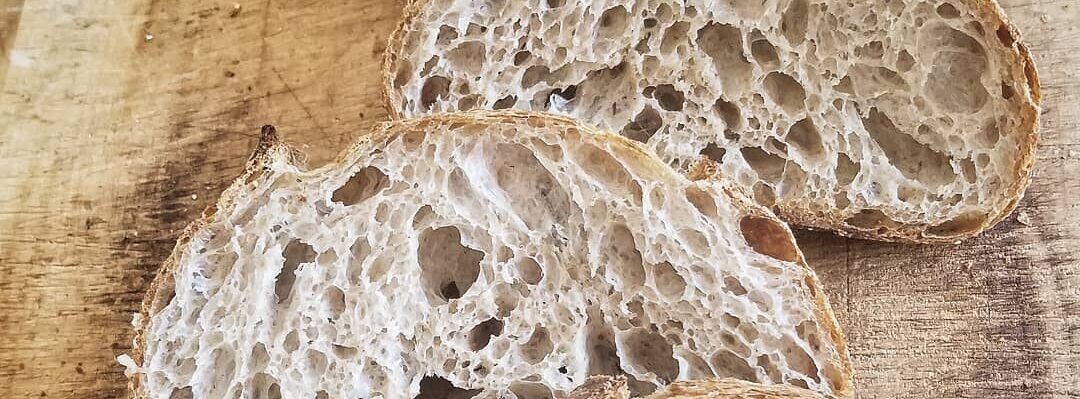

Note: This is a very long post. The discussion strays far beyond what the title suggests. But it’s worth reading in its entirety, in my humble opinion. So if you don’t have 45 minutes or so to spare at the moment (or longer, if you explore all the links), then perhaps just jump ahead to the Instructions to make the bread, and consider bookmarking this post and returning when you have time to read it in full.
This is a post that’s been a long time in the making. In fact, I actually made a version of it years ago (back in 2018) — and even made a complete video, no less. But I never actually published the post or video. After getting it all finished up after a week’s worth of work, I remember thinking to myself, “Finally done! I’ll publish it first thing tomorrow morning when I get up.” I even remember the day, it would have been a Sunday.
Why didn’t I post it?
I don’t really have a good reason. I remember hesitating to hit the “Publish” button the next morning, thinking that maybe I’d review it one more time to make sure it was ready for publication (I’d already reviewed it multiple times, so that was a poor excuse). So I reviewed it (seemed fine to me) then told myself that I’d publish it Monday. But again, I didn’t. For the same poor excuse. One day stretched into another and another, and basically I just kind of dropped the ball. Eventually, as more time passed, I even quit updating my blog and posting youtube videos entirely, preferring to focus on my Instagram account (all new and shiny and fun back then). In the end, my old website fell into disrepair, quit functioning properly, and died a slow agonizing death. My bad.
Unfortunately, when my website quit working I lost my blog post along with it. And at around the same time, my laptop broke and I lost the Pioneer video also. Guess I should’ve had backups. Oops. So anyway, here we are now in 2025 — on a new website — and it’s finally time to get this bad boy done and over with! I’ve made some changes since back then, and I think this will actually be a better version. Of course, I had a much bigger audience for my blog (and youtube videos) back then, so not as many people will ever see this new and improved version. But for you, the fortunate reader who’s actually managed to find me here after all these long years, you have the privilege of getting the very best version of this recipe. Congratulations!
I think part of the reason I hemmed and hawed so long about publishing that original Pioneer post was because this bread is so very near and dear to my heart, and I just didn’t want to mess it up. I wanted to offer up a worthy homage to the actual Pioneer French Bread of my youth, and I just didn’t feel that I might truly be up to the task. I still don’t feel worthy, but if I don’t do it, who will? (As a brief aside, I almost dropped the ball again. I took a two-month break in the middle of writing this post, which could have easily turned into another multiyear break!) So let me introduce you to that most legendary of Southern California breads, long shuttered from production, but never to be forgotten . . .
Pioneer French Bread

The first thing to understand is that I named this homage “Pioneer Sourdough” as a tribute to the bread made by the Pioneer French Bakery in Venice, CA back in the day. I did not name it in tribute to the pioneers of American western lore (though I’m sure the bakery itself was named after them). This recipe is my feeble attempt to replicate their famous sourdough loaves. Well, maybe not replicate, but at least pay tribute to. For those in the know, you surely understand my great admiration for their bread. But if you’re not in the know, then clearly you are not from Southern California and/or you’re not Gen X or older. And if you do happen to fall into both of those categories, but still don’t know about them, then shame . . . shame on you.
Now let me regale you with the tales of Southern California’s finest sourdough . . .
Let’s start with the bread itself. By today’s standards, this would be a seemingly boring all-white, soft crusted, slightly open-crumbed loaf of sourdough bread. But the crust was only soft because it was bagged in plastic bags, and all-white bread was pretty standard for the day. As for the crumb, it was actually somewhat open and irregular for a bread back then. My initial memories of this bread come from the late 80’s and early 90’s, and I specifically remember wondering why there were so many strange oversized holes scattered here and there throughout the loaf. This was years before I became a baker, before I even really knew what sourdough actually was. Compared to the open-crumb showpieces of today, it would seem unimpressive and boring, but at the time it was unusual to see anything more open than Wonder Bread, so it stood out.
But this bread wasn’t about the crust or crumb, it was about the flavor. Having grown up on said Wonder Bread and its copycats, I’d never tasted anything like this. It was tart. Kind of like a green apple. It gave a little tingle to the sides of your tongue. But it wasn’t acidic like yogurt or vinegar. More of a clean tanginess, not a funky sourness. It was very pleasant and very tasty. And the flavor was quite intense — it hit you immediately at first bite. Oftentimes you need to chew sourdough for a moment before the flavor starts to shine through, but not so with Pioneer French Bread. The flavor was upfront, as was its aroma. You could smell it through the plastic bags it was packaged in. It titillated the nose.

The Basque Connection
Now, I’ve never had the old-school San Francisco sourdough bread that is so famous (in this part of the world), and so difficult to replicate; so I can’t give a first-hand comparison between those classic breads and Pioneer French Bread. However, I have read anecdotally from a couple sources that said it compared quite favorably. So in my mind, that’s how I imagine those old San Francisco sourdough breads tasted.
Does that seem like a stretch? Too much of a guess? A leap too far?
Well, there is reason to suspect that it might very well be true. Or at least, it’s possibly true. You see, the Pioneer French Bakery was founded by a Basque immigrant who immigrated to America in the late 1800’s. That’s right, he was Basque. He was originally a baker in Southern France, and he brought his sourdough starter with him when he came to America. Why’s that important? Well . . .
One of the most famous of the original San Francisco sourdough bakeries was Larraburu Brothers. Of course, each of those old bakeries (including also, Boudin, Parisian, Colombo, and others) had their fans, but Larraburu — from what I can tell — was at the top in the eyes of many aficionados, and the most popular as well. And guess what? The Larraburu brothers were also Basque immigrants. They also brought their sourdough starter from their homeland.
Coincidence?
One of the original San Francisco sourdough researchers, T. Frank Sugihara, had this to say in the “Handbook of Dough Fermentations” . . .
“With the recent interest and increase in sourdough breads around the country, numerous popular articles have appeared in magazines and books. The various authors seem to feel that the “sourdough starter” originated in southern Europe, more precisely the Basque country. In fact, one of the oldest bakeries in San Francisco was founded more than 100 year ago (during the Gold Rush days) by Basque immigrants.”
Now, I know that was a while back, and our sourdough science has come a long way since then, but . . . could there be some truth in there? What about all the prospectors that flooded San Francisco during the California Gold Rush of 1849? There was a wave of Basque immigration out west specifically to join the Gold Rush. And as we all know, the gold miners were famous for keeping sourdough starters. Legend has it that Isidore Boudin, one of the original founders of Boudin San Francisco Sourdough (the last that still remains of those early sourdough bakeries), originally obtained her sourdough starter from one of those 49ers. Is it true? Could this legendary prospector have perchance been a Basque immigrant? Who knows? But the possibility is intriguing, and it makes for a good story (sometimes stories are more important than facts, especially when it comes to sourdough lore).
Many of those Basque goldminers eventually turned to sheepherding, and I’ve heard tale of wonderful sourdough starters originally spreading out of the Basque sheepherding community in and around Bakersfield in Kern County. In fact, the founder of Pioneer French Bread, Jean Baptiste Garacochea, first made his home in Tehachapi (just a little over 30 miles southeast of Bakersfield) when he arrived in the United States, before later moving down to Southern California.
So am I perhaps just being a bit conspiracy minded here? Or is there maybe some truth to this notion that there might actually be a special strain (or strains) of sourdough starter originating out of the Basque Country?
There’s a fellow on youtube, Eugenio Monesma, who’s built up an absolute treasure trove of videos documenting lost trades, traditional crafts and skills, and ancestral cooking throughout Spain. He’s been documenting these things since the early 90’s, and several of his documentaries focus on village baking. And I do mean village baking, as in the entire village coming together to share the work as they bake the bread. The old way. Baked in an ancient wood fired oven, hand-mixed and kneaded in an antique wooden trough, leavened from a piece of old dough that they kept from their previous bake, for who knows how many generations . . . probably dating far back into the days of antiquity.
This is bread-baking as a genuine time-honored tradition. And quite a few of those villages are located in, or right near, the broader Spanish Basque Country (the Basque Region has been split by the ever-shifting borders of France and Spain for centuries). Here’s a quartet of wonderful village-baking videos to charm and captivate you: Arcera, Anento, Zureda, San Juan De Plan. Watching some of those videos, it’s hard to believe that the sourdough starter these Basque (and nearby) villagers are using, up in the Pyrenees Mountains and surrounding areas, passed on for countless generations, is anything other than truly special. I just can’t imagine that it’s basically like any other ordinary sourdough starter; whipped up by the likes of Susie the Sourdough TikToker in her shiny, spotless, sterile suburban kitchen. (If you happen to be a sourdough TikToker named Susie, no offense intended — I just like how it rolls off the tongue.)
Yes, yes; I know that many of the same sourdough microorganisms are found all over the world. And I know plenty of folks say one sourdough starter is pretty much the same as any other. But I’ve worked with enough sourdough starters to know for a fact that some are quite different from all the rest. Some truly stand out.
Some . . . are special.
So yeah, perhaps I’m reading a bit too much into these things. Making connections that don’t really exist. Jumping to conclusions with too little information. Maybe I’m guilty of romanticizing. Perhaps it’s all just a big nothingburger. You know, correlation doesn’t imply causation, and all that. But then again . . . maybe. Just maybe.
One thing I do know for sure though, the Pioneer French Bread was made from a special sourdough starter. I have no doubt about that. I’ve worked with many, many sourdough starters. Some I made, some I bought, some were at the bakeries I worked at. Many of these starters were quite similar, some were a bit different (for good or ill), but only a select few have I ever considered genuinely special. I can literally count on one hand (three fingers, actually) the number of truly stand-out sourdough starters I’ve had the pleasure of working with.
The flavor of Pioneer French Bread was special, and therefore so was its starter.
(As a humble appeal, if by chance, you or anyone you know happens to have a piece of this sourdough starter — and if you’re willing to share it with a sad and unworthy soul such as myself — I would be eternally grateful and count you a friend for life and beyond. I’m not being facetious, this is a sincere plea.)
About Pioneer French Bakery

Before we finally get to the actual recipe I’ve posted here for you, I just want to share a bit of the history of this singular sourdough bread. Originally, I planned to link to an old (and wonderful) article by Ann Herold in Los Angeles Magazine that goes quite in-depth into the history of Pioneer French Bakery. It was published way back in 2011 (seems like a lifetime ago) and had been available online for these many long years. But to my great horror, when I looked it up to link to this post, I discovered that the article has since been taken down. It must have been fairly recently because I’m pretty sure I’ve looked it up within the last year or so and it was still available.
What a loss.
Nevertheless, nothing ever truly disappears from the internet. So how good is your Google-Fu? Are you a skilled internet sleuth? Can you squeeze even the most obscure bits of information from the popular AI chatbots of the day? I can’t link to any versions of this article that might be floating around out there due to copyright issues. However, with a bit of diligence you might be able to find something on your own . . .
The name of the article is, “The Sons Also Rise”.
Here’s the lede . . . “For nearly a century the Garacochea family made L.A.’s greatest bread.”
All the rest of the info you need for searching can be found scattered throughout this blog post. Now get to work . . .
(UPDATE: Apparently the article is back up!!! Thank you very much to a thoughtful reader who pointed it out to me. I swear, I wasn’t the only one that noticed it had been taken down for a while. So ignore everything you read above, and just click here to read this fantastic article: The Sons Also Rise.)
But for those who are not quite so skilled in the art of internet search (or who simply don’t care enough to bother), here’s a brief synopsis of the article. Very brief. The original is full of color, depth and detail that’s lacking in this summary. It even covers some of their bread making process. If that doesn’t get you to search for the article then I guess nothing will. So here’s the token summary I can offer you (along with a bit of info I picked up from other sources) . . .
In 1899, Jean Baptiste Garacochea — then only 16 years old — left his home in Les Aldudes (in the French Pyrenees) and emigrated to to the United States (originally to Tehachapi, as previously mentioned). He brought a piece of the sourdough starter from his father’s bakery with him. The starter had been in his family since the 1700’s, but I don’t know anything more about its origins than that.
After a few years in Tehachapi he moved down to Santa Monica in Southern California (near Los Angeles), and in 1908 — at the age of 25 — he opened the “National French Bakery,” selling large three-pound and five-pound boules to the local farmers, as well as a red wine that he made from Bakersfield grapes. In 1917 Santa Monica became a dry city, so he moved a few miles south to Venice, where alcohol was still legal.

In 1939 the company was renamed “Pioneer French Baking Company,” and sadly, in 1940, Jean Baptiste passed away at the age of 57. The bakery passed to his son, also named Jean Baptiste (nicknamed Bap), and when he passed away in 1969 the bakery passed to his son Jack. It had grown significantly since its inception on the strength of their wonderful sourdough bread. In 1976 Jack opened the “Pioneer Boulangerie,” a popular Basque-themed eatery where they sold their famous sourdough bread alongside traditional Basque cuisine. And the business continued to flourish.
In the late 80’s Jack’s son, John, took over the company — the 4th generation of Garacocheas to run the business. By this time their bread had become immensely popular throughout the region. In 1990, unable to meet the demand, they opened a brand-new 90,000 sq. ft. warehouse in Oxnard — about 50 to 60 miles north of Venice — where they focused on parbaked bread which they would ship frozen to grocery stores all over Southern California and beyond (even east of the Mississippi River). Oxnard borders the city of Ventura — where I grew up and was living at the time — and it’s a major agricultural hub full of farms and orchards (at least it was back then, not sure what it’s like nowadays).
My dad worked at a citrus processing facility right up the road from the Oxnard Pioneer factory, just a few buildings away on the same industrial block. I can recall visiting his worksite on a couple occasions when Pioneer was baking (I think it was a 24-hour operation, so they were probably baking quite frequently) and the smell was intoxicating. It absolutely saturated the air over the entire neighborhood. They were baking thousands of pounds of their sourdough at a time, so you can just imagine the intensity of the aroma. My dad absolutely loved it, so it’s no surprise that we always had a loaf or two of Pioneer French Bread on our counter at home. I don’t think we ever ran out of it.
Unfortunately, even with such a large production facility, Pioneer still couldn’t keep up with demand. Rather than build an expensive new factory to increase supply, they decided to sell their Oxnard facility to a Canadian conglomerate in 1996; and by 2007 the rest of the business had also been sold off to a developer who had big plans that unfortunately fell through. After almost a century, the family business was finally shuttered. A sad end for such magnificent bread, no doubt. But business is business, and sometimes businesses — even those most beloved — have to close. That’s just the way it goes.
In those years, I was a young adult. I’d first moved to Vermont in 1998, did a little hopping back and forth between Vermont and California for a few years, then finally settled here permanently in 2001. I believe the Oxnard facility was still selling parbaked bread labeled as Pioneer, but I’ve heard the quality declined significantly sometime after the buyout. At the time, I had no idea that anything had been going on with the bakery — to my knowledge, it was still business as usual.

It wasn’t until Christmas day of 1999 that I baked my very first loaf of bread (a cinnamon raisin brick that not a single relative, wisely, dared try). Failure though it was, that experience uncovered a passion which still holds me captive to this day. Soon after, I learned about sourdough when I read Shirley Corrihor’s excellent book, “Cookwise,” (not an affiliate link) and that’s when I realized why the Pioneer French Bread was so different compared to the Wonder Bread (and such) that I’d been raised on. That’s when I caught the sourdough bug and became obsessed! In my ignorance, I just assumed all sourdough tasted the same . . . like Pioneer, of course. And that’s what I really wanted most at that time — to make bread just like Pioneer.
I quickly realized I knew next to nothing about making bread, so I went and got my first baking job at a bakery here in Vermont in January or February of 2000 (I figured it was better to get paid to learn rather than paying to learn at a school). That’s when I discovered that, no, not all sourdough tastes the same. The taste of the sourdough at that bakery was fantastic (one of those truly special starters I was telling you about), but it was completely different than Pioneer, and I still missed that comforting flavor of the Pioneer French Bread that I was so familiar with.
In the summer of 2000 I moved back to California for about 9 months or so, and that’s when I made my first sourdough starter. Well, I had actually made one back in Vermont, but I had no idea what I was doing and it had never really got going, so eventually I dumped it. I was hoping that this new sourdough starter would have that same Pioneer flavor since I was making it in California. Back then it was still commonly believed that the characteristics of a sourdough starter were purely determined by region, so I figured that the Pioneer flavor was simply the Southern California flavor (I had no idea of Pioneer’s Basque heritage at the time, which just goes to show that I don’t pay attention to labels).

But oh how wrong I was.
The flavor of my new starter was nothing like Pioneer. Not even close. It was quite bland in fact, at least in the beginning. Fortunately, the flavor of that starter slowly improved over several months, and eventually it became quite tasty. But still, it was no Pioneer. This experience is what led to my never-ending quest for the perfect sourdough starter (which, for me, could be nothing other than the original Pioneer starter).
Back in 2015 I spent about 6 months visiting friends and family in California, and the thing I was most looking forward to (besides seeing my family, of course) was tasting that wonderful Pioneer sourdough again. But to my great horror, that’s when I finally discovered that it was no longer available! I was told that the business had shut down years prior, and the bread had long since disappeared from the market shelves. I cannot describe how disappointed I was. No other bread could take its place. I’ve been lamenting the loss of Pioneer ever since, and that’s what eventually led me to create this homage.
Now let me discuss just a bit more about Pioneer French Bread before I finally move on to the actual bread making part of this long blog post. With the way I’ve been building it up, I’m sure it sounds practically mythical by this point!
Evaluating Pioneer French Bread (with some background context and a rant)

I think it’s important to assess the quality of Pioneer in light of modern-day standards. Not because modern-day standards are superior (trust me, I hold tradition in far higher esteem than anything “modern-day”), but because I want to provide a defense for a style of bread that modern-day attitudes might (arrogantly and mistakenly) hold in low regard, or dismiss as inferior quality. Perhaps, some might even consider it beneath them. I feel a bit of a rant coming on, so grab a beer and sit back . . .
Pioneer was not the type of bread that you would find nowadays at a posh restaurant by the pier in some wealthy California enclave (though back in the 80’s, it was precisely the kind of bread you would find there). Pioneer was not some exceedingly dark, crusty, high-hydration, open-crumbed loaf of bread. The crust was fairly light, and soft from being packaged in plastic. The crumb was not open by today’s standards, though as I already mentioned, it had some openness by the standards back then. It was not a moist custardy style of bread. Oh, and it was made entirely from white flour. Yep, just plain ol’ white flour. No exotic heritage grains, no sprouted grains, no flashy add-ins, not even a touch of regular whole wheat to fancy it up for the tastes of high society.
The bread wasn’t mixed by hand in small batches, shaped by Cordon Bleu Certified Master Bakers, or baked in a wood-fired oven deep in the forested hills of Vermont. It was factory white bread. Not like Wonder Bread, to be sure, but made in a factory nonetheless. And yet it was absolutely wonderful! It aways made our simple family dinners seem special when we served toasted Pioneer alongside our meal. It made even a plain ham and cheese sandwich taste like haute cuisine. And don’t get me started on the french toast! Challah couldn’t even hold a candle to it.
But this bread wouldn’t be classified as “artisanal” in the modern sense. Maybe it was back when it was still just a small operation run by a family of bakers in the early 20th century, but certainly not by the time it had spread all across Southern California (and beyond). This lightly baked, soft-crusted, lower hydration, all-white factory bread would be heaped with scorn by many of today’s new crop of artisan bakers. Or at the very least, it would be looked upon with disdain by a small, but viciously loud minority of bread baking enthusiasts.
Pioneer was shutting down just as the artisan bread movement was starting to gain real steam here in the United States. The movement had its roots much further in the past, with the back-to-the-land movement of the 60’s and 70’s (read this wonderful article from Chuck Conway of O Bread, one of the early pioneer’s of the artisan bread movement, whom I had the honor to work for and learn from), as well as the macrobiotic diet subculture of the 70’s and 80’s, (read about Richard Bourdon who was a mentor to both Chad Robertson and Dave Miller — Dave is the baker who provided the very first lesson in hand-mixing I ever had, at the first Brick Oven Baker’s Conference in Sausalito, back in 2000, I think; the video in the link is from a later conference than the one I attended), and the growing appreciation for European cuisine and peasant fare (read about Daniel Leader of Bread Alone and Michael London, whose methods I learned at my first baking job, and who also instructed Zingerman’s Bakehouse, among others).
The burgeoning farm-to-table movement, exemplified by the likes of Alice Waters at Chez Panisse, directly inspired early artisan bakers (Steve Sullivan, the founder of Acme Bread Company in the San Francisco Bay Area, originally got his start baking bread for Alice Waters at Chez Panisse). Napa Valley-style “Cuisine Bourgeoise” practically demanded dark, crusty country bread as pairing for any halfway respectable meal.
By the time I started baking bread, at the turn of the millenium, the “artisan” style of bread was pretty much set. Dark crusty sourdough, traditional French baguettes, Italian ciabatta, multigrain hearth bread, heavy German rye, seeded black bread, and dense wholegrain were pretty much staples at most artisan bakeries. Serving these breads became something of a status symbol. Simultaneously, the home baking movement was also gaining momentum with the emergence of the internet and baking newsgroups and forums. Home bakers latched onto the styles of bread that were baked at their favorite bakeries; and the rise of a new phenomenon — the celebrity baker — shaped the methods and opinions of all the bakers formed in their wake. Lionel Poilâne may have been the first, but he was far from the last.
And then came social media.
Here’s where things started to get out of hand. Social media doesn’t expose us to new ideas, as we may think, it corrals us into smaller and smaller thought bubbles. The algorithms silo us. They polarize us. We see this most clearly with politics, but it happens in all areas of communication . . . even seemingly harmless discussions about bread baking.
A certain idea about bread had been slowly spreading throughout the artisan bread baking movement in the lead-up to the social media boom. The notion was that the higher the hydration, and the more open the crumb, the better the bread. Ciabatta was an early example. Another example, loosely inspired by French Country bread (I believe), was Chad Robertson’s Tartine bread. Very wet dough, very open crumb, very dark crust. This style of bread, quite challenging to produce, was starting to gain popularity in certain regions. And when Chad published his book, “Tartine Bread,” the popularity of that style absolutely exploded. Bakers all over the world, both professional and amateur, were enthralled. Myself included. Suddenly, bakeries started popping up all over the place selling Tartine-inspired breads.
This coincided with the emergence of social media, and so the popularity of Tartine-style bread was amplified even further. This style of bread is practically made for social media. With deep mahogany crust and an open, molten crumb; it’s a photographer’s dream! Naturally, this style of bread took over the scene entirely, and to the exclusion of many other types of bread. Everyone wanted to make Tartine-style bread, and I’m just as guilty as anyone else. When I started my original blog (Breadwerx) in 2015, and took up social media in 2016, I mostly posted this same style of bread (I still do, but I’ve dialed it back a bit). When I saw all the incredible breads everyone else was posting, I was slightly intimidated. I had to up my game!
My contribution to this trend was “Open Crumb Mastery.” I saw that many folks wanted to make Tartine-style breads, but were having difficulty for a variety of reasons, not the least of which was bad advice that was common at the time (and still common today, though to a lesser extent). I started writing it at the end of Spring in 2015, and finally published it November 11th, 2017. I released the 2nd edition towards the end of July in 2019. For a self-published, non-advertised, underground text; it’s been quite influential, if I do say so myself. It’s not bragging to say that you’d be surprised how many of your favorite influencers — or the influencers who influenced your favorite influencers — learned to successfully bake that difficult style of bread thanks in part to my book. Well, maybe it’s bragging a little. Forgive me.
But the problem is that this style of bread was becoming the end all be all of modern-day bread baking culture. At least, it was here in the U.S., where we have little in the way of ancient baking tradition to keep us grounded. Social media was practically force-feeding us more and more of Tartine-style bread. It was everywhere, and all the cool kids were doing it. Cliques formed. Acceptable opinion narrowed. And disdain for anything other than dark, crusty, high-hydration, open-crumbed bread started to trickle into certain segments of the bread baking community.
Now we have a new crop of bread bakers, particularly home bakers, who’ve gained almost the entirety of their knowledge online and from social media. The flood of new enthusiasts who took up baking during the lockdowns had very little exposure to the great multitude of breads from all around the world. By the time they started their search for baking information, practically the entire internet was fully saturated with Tartine-style bread, and all the praise and adoration that accompanied it. You really had to go out of your way to find alternative thinking about bread baking. They never had a chance.
So these new bread bakers, immersed in the echo chambers of social media, adopt the only ideas they’ve been exposed to. Worse yet, some of them also adopt the disdain and hubris that’s been circulating. It feels good to be one of the cool kids. To be in the know. Yet they have no knowledge of craft; no sense of what came before; and no awareness of their own limited experience. Nevertheless, they’re already masters in their own mind. This is just basic Dunning-Kruger Effect 101 . . .

You can easily trace a line of thought — slowly distorted with each new generation — from the traditional bakers who practice their time-honored craft to feed their local community, down to the modern-day talking heads who seem to proliferate more and more on social media these days. Disconnected from any sense of tradition, and formed in a bubble of narrow opinion, they condescendingly deride any and all bakers who might stray even just one iota from their limited set of approved baking methods. In reality, all they accomplish is to loudly proclaim their ignorance and arrogance to anyone with actual experience in the craft. It’s easy for all to see, and you can spot them a mile away. They might as well be wearing a dunce cap. And unfortunately, it’s almost impossible to engage in constructive conversation with these ignorant know-it-alls. They’re far too intoxicated by their own superiority complex.
Here’s how the line of thinking goes . . .
Traditional Baker: “This is the bread we bake. This is how we’ve always made it. I learned this craft from my father, who learned it from his father, who learned it from his father . . . for countless generations. This is the bread of my people.”
Traditional Baker’s Apprentice (who later opens an upscale bakery, writes a book and becomes famous): “This is the bread I love. Traditional. Rustic. Wholesome. I want to share this bread with the rest of the world.”
Major Bread Influencer (who read the famous Apprentice’s book): “This is bread as it should be made. It’s better than the factory-made stuff you grew up on. This is real bread.”
Minor Bread Influencer (who read every single blog post Major Bread Influencer ever wrote, twice): “This is the only bread you should ever bake. All the rest is fake bread. Why would you want to bake fake bread?”
Talking Head (who just started baking last week and watched a couple TikToks by Minor Bread Influencer): “You’re so stupid! Don’t you know anything?! This is how you’re supposed to make bread! I don’t know what you’re doing, but it must be dumb because I’ve never seen anyone make bread like that. You need to educate yourself.”
Now before you say anything, I know what you’re thinking. But no, none of these categories are in reference to any single individual. So no, “Traditional Baker’s Apprentice” is not Chad Robertson. There’s whole host of bakers who fit that bill, so you’re probably more off-target than you think.
The fact is that each of these categories represents a caricature, a template formed from common traits I’ve noticed over the years, since the very start of my baking career. These common traits apply to many different bakers, so don’t jump to conclusions. In fact, I could (and did) include myself among some of these categories; at various stages of my own development as a baker.
To be completely honest, I could’ve fit right in as one of the “talking heads” back when I first started baking. Or at least, I would’ve if social media existed back then. Fortunately, it didn’t. And I should thank God every day that the idiocy of my own youth took place during a time before the internet and social media recorded every idiotic decision or statement one makes for the whole world to see for all eternity. I feel bad for the youth of today, who will forever be held to account for the dumb things they do and say while still young and foolish. It’s quite unfair.
But yes, had social media existed back when I first started baking, I too would’ve gone around loudly proclaiming the superiority of the dark, crusty, “Euorpean-style” hearth breads that were starting to gain popularity back then. For you see, I too had read a couple of books. And in my impressionable youth, I quickly (and uncritically) adopted the authors’ opinions as my own. And I mean no slight to those authors. Their books are wonderful. But students usually take the ideas of their teachers much further than the teachers ever intended. So I would’ve been the one wearing the dunce cap. Smugly. Fortunately for me, without any social media back then, my stupid opinions were limited to sharing with just a few friends and coworkers. Fate, it seems, let me off the hook.
So if you recognize any of these tendencies in yourself, don’t be offended. Be grateful! Recognition is the first step towards rehabilitation. And if I could be rehabilitated, anyone can. I don’t hold a grudge towards the talking heads of today (no matter how obtuse and obnoxious they can be at times) because I understand exactly how they think. I thought that way myself once. Most of them are just young and dumb. We tend to grow out of our ignorance as the years pass by. But if you’re over 40 (and I know a few are) and still think it’s okay to spam someone’s comment section with arrogant, rude, condescending criticisms; then you need sit down and have a reckoning with yourself. You’re too old to act so immaturely. Time to grow up.
Well, that was quite the rant! My apologies for the long and preachy detour. Let’s see if we can get back on track . . .
My entire point for going into such detailed history is to show exactly how the standards of today were set, and to illustrate how they’ve been corrupted by the narrow “acceptable” opinions formed by the algorithms and talking heads of social media. If it’s not dark-to-the-point-of-burnt, if it’s not 1000% hydration, if the crumb isn’t open like Swiss cheese; then it’s not real bread. Full stop.
By these standards, Pioneer fails.
Fortunately, back then we didn’t have such warped standards. There was only one standard: “Does this bread taste good?” By that standard, Pioneer passed with flying colors. Furthermore, it was available to all. It was widely distributed throughout the region, affordable, and a favorite among the local populace. It was not a bread only for the rich. It appealed to both working-class and elite alike. You would find it in pretty much everyone’s household, no matter their station in life.
It was a true “bread of the people.”
So at first glance, in light of modern-day standards, Pioneer may appear to have been an inferior loaf of bread — having failed the crust and crumb test of today, and lacking in “artisanal” bona fides — in reality, it was an outstanding bread in every category that mattered to the actual people it was made for. That’s what truly defines the quality of a bread, not the arbitrary litmus tests that social media talking heads smugly judge the rest of us by.
The loss of Pioneer French Bread was a loss to us all.
Pioneer Sourdough Instructions

Phew! That was quite the discussion. If you actually read all that (and explored the links) then my hat’s off to you. You came here for a bread recipe and instead you got documentaries about village baking in the Basque region, some history lessons, a little autobiography, and a preachy lecture all rolled up into one. More than folks asked for, and probably more than anyone wanted, but sometimes I just can’t help myself. I start writing and everything just spills out. Oh well, what’s done is done. In this dystopian age smothered with AI slop, maybe it’s best to just let my wandering mind do its thing. It might be a little meandering and unfocused, but at least it’s human. Now let’s move on . . .
About the Method
Before I get to the actual directions, I want to discuss the method we’re going to use for this recipe. As I often say, the method makes the bread, and that’s especially true in this case. You can use the exact same recipe, but if you don’t use this same method then you’re going to get a different bread entirely. It will still probably be a good bread, but it won’t be this bread.
The method we’re going to use is a traditional baking technique most often associated with commercial yeast breads. It’s pretty simple: let the dough double in volume during bulk, punch it down, then let it double again, and punch it down again to mark the end of bulk fermentation. And just for good measure, when you shape the loaf you knock out the gas one last time.
This provides a twofold effect: 1) the periodic degassing of the dough is what gives this bread its distinctive crumb texture, and 2) the extended fermentation is what gives the bread its deep flavor. Let me elaborate on these points a bit . . .
Texture

When you let a dough double during bulk (specifically a low hydration dough), then punch it down and let it double again, you’re creating a particular type of dough structure: highly inflated, but with very fine alveoli (holes) rather than big alveoli. Of course, there will still be some pockets of larger air bubbles here and there — that’s fairly inevitable in a hand-made dough — but the overall effect is a more uniform and finely perforated dough structure. And that leads to a light and airy bread with a fine and tender crumb.
It may seem counterintuitive that degassing your dough multiple times with punch-downs leads to an airier and lighter loaf, but indeed, that is exactly what you end up with (assuming everything else goes according to plan, of course). Yes, degassing knocks out the gas . . . but not all of it. And the gas that remains gets redistributed throughout the dough.
Furthermore, the dough actually gains in strength. Its ability to retain gas is increased. And this effect compounds when you let it double and punch it down a second time. You can really feel this increased strength when you punch it down again after the second doubling. Throw in one more degassing at the time of shaping, and what you’ve done is to create an extremely strong and well-structured dough with the ability to retain a ton of gas during the final proof. The end result is a loaf with wonderful shape, height and volume; and a crumb that’s light and airy with a fine, even texture that’s fluffy and easy on the tooth. Soft and tender, not chewy or custardy; both kid-friendly and geezer-friendly. I may elaborate on this in a future post.
I have two cautions about this method: 1) this works best with low hydration — wet dough can become a sloppy nightmare with this technique, so if you try it with high hydration, don’t say I didn’t warn you; 2) because of the extended fermentation that takes place with this method, there’s the possibility of dough degradation from acid exposure — not typically a problem for yeast bread, but certainly a risk with sourdough — so it’s important to have a healthy and active sourdough starter, and to use flour with sufficient protein to handle the long fermentation (10.5% minimum, but 11.5% and higher preferred).
If you only have access to weaker flour that can’t handle the long fermentation, then you can still achieve some of the effect by simply eliminating the second doubling during bulk. Just punch it down after the first doubling (or tripling, if you think you can get away with it), preshape it, then knock out the gas again when you shape. You’ll still be improving the strength and structure of your dough, and increasing it’s ability to retain gas. You’ll still get a lighter, softer, and finer crumb; just not as pronounced as with stronger flour. But on the plus side, weaker flour makes for a more tender crumb by its very nature, so by utilizing this method you can really emphasize that tenderness.
Extended Fermentation
Fermentation is flavor, so by extending the fermentation you naturally increase the flavor. This is the key to achieving the most flavor that your particular starter can muster. The fact of the matter is that not every starter is capable of imparting strong flavor. Some are just naturally milder than others. I’ve worked with starters that can achieve a degree of flavor in 6 hours compared to others I’ve used that require a full 12 hours to attain something commensurate.
If your starter is on the milder side, then this method will bring out a fuller flavor. If your starter is on the stronger side, then this method might actually create too robust a flavor. It’s always a matter of personal preference. My taste tends towards stronger flavors, so I usually try to extend fermentation as far as possible.
But there’s a great deal of variety in starter flavors. And I’m not just talking about acidity, though that’s certainly a factor that varies from starter to starter as well. I’ve used some starters that make wonderfully flavored and tangy white bread after a 12 hour extended fermentation, whereas baking wholegrain bread with the same starter and a prolonged fermentation (or even close to it) brings out unpleasant bitter and sour flavors. And yet, I’ve also used starters that make both wonderful white and wholegrain bread when extending the fermentation. Yes, starters can vary.
So while I can confidently tell you that using this method to extend the fermentation will bring about the most flavor from your starter, I can’t tell you whether that’s going to actually taste good. That comes down to your own personal preference and your starter’s flavor profile. I actually have a whole lot to say about starters, but I’ll save that for another post (or more likely, another book).
But practically all sourdough starters that I’ve used with this method are fine when making white bread. And since this recipe is a white bread, I think that most of you will be okay. Again though, that assumes you’re using a healthy and active sourdough starter. Long fermentations from unhealthy or inactive starters can make foul tasting bread; that is, if your dough doesn’t completely disintegrate on you beforehand.
One Last Note
In this recipe I’ve used 10% starter as a percentage of total dough weight (not baker’s percentage). But in practice, I typically go with 5%, or sometimes even 2.5%. The more active your sourdough starter, the quicker it raises dough; the quicker it raises dough, the less of it you should use. The point is to extend the fermentation for maximum flavor. A dough that rises too quickly won’t have as much flavor. I base this suggestion on my own personal experience.
Less Starter + Longer Rise = Greater Flavor than More Starter + Shorter Rise.
If your own personal experience says otherwise, then feel free to ignore my suggestion. Personally, I aim for an absolute minimum total fermentation time (from start of mix to end of final proof) of at least 10 hours, though 12 is preferred (something like 8.5 hour bulk — punched down at the 6 to 7 hour mark — then 30 minute bench rest and 3 hour final proof). Sometimes I can even get it to 13 or 14 hours (tops) without any overproofing or dough degradation. This is uncommon, but always a nice treat when it happens. Keep in mind that I’m talking about room temperature fermentation here, not time in the fridge. And I’m using starter that has been fermented for a full 10-12 hours before going into the bread. I’m not using young leaven.
So depending on the activity level of your starter, you may need to adjust the amount you use in this recipe in order to approach the 12-hour mark. I wrote this recipe under the assumption that most bakers (especially those who find the recipe on youtube, but otherwise don’t follow me) won’t have as active a sourdough starter as I do. I figure 10% is a good range for the average baker, so that’s what I used for the recipe. Again, adjust as necessary.
I managed to squeeze out 11 full hours of fermentation using 10% starter with this particular loaf (6 hours bulk till doubled, punch down then another 1.5 hours bulk, 30 minute bench rest, 3 hour final proof), but the dough was just starting to degrade by the time I baked it. You can see the dough tearing at the upper edge of the loaf in the video when I unwrap the cloth before scoring. Not ideal, but not enough degradation to do much harm.
Alrighty then, now that we’ve got that out of the way let’s move on to the recipe . . .
Formula
- 100% Bread Flour
- 65% Water
- 10% Sourdough Starter (as a percentage of total dough weight)
- 2% Salt
Recipe (≈800g Loaf)
- 445g Bread Flour
- 275g Water
- 80g Sourdough Starter
- 10g Salt
Mixing
This is a pretty simple mix. The video demonstrates the technique better than I can explain it, but I’ll give it a go. Basically, just add all the ingredients together (direct mix, no autolyse) and stir it up until it comes together in a lump. Then start rolling the lump of dough into its center, pushing the dough into itself with your thumb or palm. Keep it up until the dough becomes more cohesive — no major wet or dry spots, no rough clumps or crumbly bits. It doesn’t need to be smooth, but it should be fairly uniform. Then cover the dough and let it rest for an hour.
During this hour the flour will continue to absorb the water, gluten will begin to form, and the dough will become less sticky and more cohesive. After the hour rest, smooth out the dough using the same rolling technique as you used when mixing. Just keep pressing the dough into itself until the surface becomes smooth and taut. It shouldn’t take long; a minute or two max. Once it’s nice and tight, stop. Don’t keep rolling the dough to the point where it begins to tear. Just get it smooth and tight, and then leave it be.
Bulk Fermentation
The length of bulk fermentation is going to vary depending on how quickly your dough is rising. Don’t measure it by time, measure it by volume rise. You want to let the dough double in volume, punch it down (as depicted in the video), then let it double again. As previously mentioned, for me that was 6 hours to double (that includes the 1 hour rest after the initial mix), then another hour and a half after punch down to double again (well, almost double). Don’t rush it. Make sure the dough doubles twice (or very close to it). If you get impatient and punch it down too early (especially the first punch down) you lessen the effect and defeat the purpose of using this method in the first place. Yes, it’s time-consuming, but that’s the price that must be paid for the proper results. If it’s too long of a method for you, then it’s not the method for you.
You’ll notice that the second doubling takes much less time than the first doubling. There’s a couple reasons for this. First, there’s a delay from the time the dough is mixed to the time that it noticeably begins to rise. This lag phase lasts longer the less starter you use, and vice versa. Basically, it’s just a period of time where the microorganisms in the starter are getting adjusted to the new environment of the dough before they really kick in to gear. This delay extends the time it takes for the dough to double the first time.
Second, after the first punch down, the dough is still filled with plenty of gas. And that’s how it should be. Don’t try to expel all the gas. Honestly, you’d need to take a rolling pin to the dough if that’s what you wanted to do. Just give it a firm punch down and fold, and let the gas escape as it may. Of course, if you notice any huge gas pockets in the dough, then go ahead and press the gas out of them. Since the dough is still partially inflated after the first punch down, and since there’s no more lag phase to wait for, the dough doubles much quicker the second time than it did the first time.
Preshape
After the dough has doubled in volume the second time, punch it down just as you did before, remove it from the bowl, and preshape it. Give the dough a 30 minute bench rest (covered). The dough should rise noticeably during these 30 minutes. That’s good. It means fermentation is quite vigorous at this point. And it gives you one last chance to degas the dough again.
Shape
Even though this is a fairly low hydration dough, I still suggest you dust the bench with a little more flour than you think is necessary; at least for the first time with this recipe. You’ll be handling the dough fairly rough as you degas it, and it might start to stick the bench more than you’d imagine.
Now then, flip the dough smooth-side down onto the floured work surface and knock out the gas from the dough. Just pat it out as you see in the video. Be firm, but don’t beat it to a pulp. Just like with the earlier punch downs, you’re not trying to expel all the gas from the dough, just the gas that comes out easily. The low hanging fruit. And again, make sure there are no large air bubbles caught in the dough before you proceed to shaping.
Once the dough is degassed, shape it in whatever way you think is best. I chose a simple cinching method for this loaf since it works so well with stronger and stiffer dough. And I like to roll out the ends into long nipples and then tuck them to the underside of the loaf to square off the ends. That keeps the ends from opening during the rise, and provides a line of tension along the length of the loaf that keeps it from spreading lengthwise in the basket (for a more even shape with less slope to the shoulders, which means more even slices of bread from end to end). The video demonstrates the method better than I explained it here.
Final Proof
The final rise will probably take around 2-3 hours, plus or minus. If all went well with the dough development during bulk, then your dough should be quite strong and have a high tolerance to proof. That means it should be able to rise quite high before it starts to overproof. So go ahead and give it a full rise. Push it a little further than you might regularly allow a loaf to rise. Test the boundaries. You want your dough to be tall and airy, shapely, and voluminous before it goes into the oven.
Remember, this dough should proof at room temperature. While you certainly can refrigerate your loaf at this point — probably out of convenience since it pretty much takes up an entire day — you won’t get quite the same result. Now truthfully, you may actually prefer the results when refrigerated. The flavor profile may be a bit more acidic, the crumb a little lighter, the shape and ovenspring improved. And if that’s what you prefer then by all means go for it. But at least once, let the dough rise entirely at a warmish room temperature (mid-70s F to low-80s F) and bake it on the same day. This provides a more “authentic” Pioneer-style quality to the bread; and to my tastes anyway, it makes for a better loaf overall. Better flavor profile, fluffier texture, softer crust. Speaking of crust . . .
Baking
Pioneer French Bread had a soft and lightly colored crust, so this bread does to. Not every loaf of sourdough needs to be given a dark “bold” bake, and not every bread benefits from a thick hearty crust. The crust of this bread should be thin and lightly tan, or golden at its darkest. To achieve that kind of crust requires two things: 1) a low temperature bake for as short of a time as you can get away with, and 2) bagging the loaf in plastic after it has cooled. So . . .
I score the loaf, then bake it at 425F/218C for 20 minutes with steam (I carefully pour boiling water into a pan filled with lava rocks to generate the steam, but use whatever method you prefer, or bake in cast iron), then I release the steam and remove the pan of rocks, rotate the loaf, lower the temperature to 400F/204C, and bake another 15 to 20 minutes without steam. Sometimes I turn the oven off for the last 5 minutes if it’s browning too quickly.
Needless to say, you don’t have to bake it at such a low temperature and to such a light color. If you truly want a dark crusty loaf then have at it. It’s your bread after all! But again, I’d suggest that you try it this way at least once in order to experience the “authentic” product. And if you intend to serve this bread to children, old folks, or others with bad teeth; then almost all of them will appreciate the lighter softer crust. I like a dark crisp crust as much as the next baker, but I think folks sometimes go overboard with it. In my experience, extremely dark crusts are promoted by many, but appreciated by few. I’m sure there’s a regional element to it as well. But don’t let anyone bully you into baking a thick dark crust if you actually prefer a thinner lighter crust.
If you intend to bag this loaf of bread in plastic in order to get the softest crust possible, then be absolutely sure that your loaf is completely cool before you bag it. Not just cool to the touch, it needs to be cool through and through. If there’s any residual heat remaining when you bag it then the loaf might sweat. This can make for a gummy crust, and might lead to premature molding. Not a pleasant thing. For an 800g loaf, I wouldn’t let it cool for anything less than 3 hours before bagging, just to be on the safe side.
Final Thoughts

I understand this loaf is an all-day affair and that such a long process won’t work for many folks. Feel free to get creative with the schedule if you must, or just wait until you have a lazy weekend day to sit around sipping on gin and tonics as this loaf slowly does its thing. For me, the long process isn’t a problem. The day I baked this loaf for the video looked like this: wake up at 5am, have a cup of coffee, mix the dough at 6am, smooth it out at 7am, punch it down after the first doubling at noon, punch it down again after the second doubling at 1:30pm, bench rest for 30 minutes then shape at 2pm, final proof 3 hours, bake at 5pm, remove from the oven a little before 6pm, let cool until 9pm, then bag it and go to bed. Enjoy the next day.
Even though its an all-day affair, there are plenty of long blocks of time where I don’t need to attend to the dough, so I can do all the things I need to do during the day. For those who work from home, it’s pretty manageable. For those who don’t, it can be more tricky. So if you need to refrigerate the dough to make the process work for you, don’t feel bad. I won’t tell anybody. Just be warned, since fermentation is so vigorous at the time of shaping, it’s probably best to toss it into the fridge immediately after you shape it so it doesn’t overproof. Even then . . .
But the long process begs the question: if you go through all this time to create this loaf, will it actually taste like the original Pioneer French Bread?
I hate to break it to you, but probably not. There’s two reasons . . .
1) Pioneer was made at a very high volume. In my experience, a large mass of dough tends to be more flavorful than a small mass of dough, all else being equal. If you take the same starter and make a single loaf of sourdough at home, then compare it to a loaf made from the same starter and the same recipe, but scaled up and baked at high volume in the bakery, the loaf made in the bakery will taste noticeably better. Both flavor and aroma will be intensified, even though the respective flavor/aroma profile will remain the same.
As far as I know, there are no studies that have researched this phenomena, at least none that I’ve run across. But I’ve personally tested and observed this myself with different starters at different bakeries. For a long time, the only evidence I could find backing up my observation was a single comment from J. Kenji López-Alt where he mentioned that he thought pizza dough tasted better when it was bulked at mass rather than at smaller volumes. Anecdotal, to be sure, but something at least.
Then a little while back I found another comment from another baker also making the same observation as I have. I copied the quote onto my computer — alongside that old quote from Kenji — but unfortunately, that computer died this last summer and I lost both quotes (I seem to have bad luck with laptops dying on me). I haven’t been able to find them again. The Kenji comment I remember the basics, but not enough to quote him directly. The quote from the other baker was more specific to bread — mentioning that he thought larger volumes of dough made better tasting bread than smaller volumes — but again, I can’t quote him directly. I won’t even name him, because even though I’m pretty sure of who the baker was, he’s fairly well-known and my memory isn’t certain enough that I’d want to risk misattributing a statement to him. So I’ll just leave it at that.
2) Unless you have a sourdough starter that happens to have the same flavor profile as the Pioneer starter (which I’ll speak to in a moment), then you’re basically out of luck. But that doesn’t mean your loaf won’t taste delicious! This method really does get the most flavor from your starter. And when you combine that deep flavor with all the other qualities you get with this bread (wonderful shape, height and volume; fluffy and tender crumb; soft and easy to chew crust), you end up with a truly stand-out loaf of bread. Trust me, this loaf is a genuine people-pleaser.
Now then, before I finally close out this way-too-long post, let me touch on that bit about starter flavor that I just alluded to. I’ve worked with many different starters, and in my experience, flavor profiles can vary quite dramatically. But that doesn’t mean that every starter tastes completely different from every other starter. Quite the opposite, in fact. Many starters are quite similar in flavor and aroma.
Over the years, I’ve come to recognize several sourdough “families” (and I’m sure there are many others besides the few I’ve noticed) — starters that are very similar to one another in their own family, though they may be quite different from a different family of starters. So each family of sourdough starters has its own “base” flavor profile, if you will, that all the starters in that family tend to possess, to one degree or another, and with some variation here and there. In fact, some starters in a family can be so close in flavor that they’re practically twins!
So is it possible that there are other starters out there that have a similar flavor profile to the Pioneer starter? Yes. Is it possible that the Pioneer starter might even have its own twin? Yes. Indeed, I know for an absolute fact that the Pioneer starter did have at least one twin. A while back I actually had the good fortune to come across one such starter.
I had been baking bread for over 15 years at the time, and it was the first (and still only) starter that made bread smelling and tasting just like Pioneer. It was a true twin! The flavor was so close as to be practically identical. Truth be told, I couldn’t make out any difference between the bread made with that particular starter and the Pioneer of cherished memory. The first time I tried a loaf made with that starter it practically brought me to tears.
You might think that since the flavor was so exact, that perhaps I just happened upon a starter that was once split-off and descended from the original Pioneer starter. I know there are some descendants out there. For proof, read these three wonderful posts from the very daughter of John Garacochea himself to hear about the actual Pioneer sourdough starter her family brought from the Pyrenees, and to see photographs of the original family bakery back in France: Starting with the Starter, A Gift, My Long Lost Sourdough.
But I know with almost 100% certainty that it was not split off from the original Pioneer, because I know the origin story of this particular starter — and I was actually a co-creator of sorts. It’s a complicated story, and there is still the slightest chance it was in fact descended from Pioneer. But the chance is so slim as to be practically negligible. Like I said, it’s kind of complicated.
But I think I’ll leave the tale of that starter, and it’s sad fate, for another day.
Cheers!
Trevor
NOTE: I wish to extend a big “Thank You!” to Mark Gorman of the “The Street Seen” Substack. He generously provided me with photos and information about Pioneer that I’d never come across. If you’re interested in more rare photographs and info about Pioneer, then I highly recommend his two posts about the bakery: Pioneer Boulangerie and Pioneer (Ocean Park). His historical streetside documenting is top-notch, and a real treasure to his local community. Thanks Mark!
Your new blog posts are a pure joy to read! Thank you for what you do!
Thank you! I’m glad you’re enjoying them!
Thanks for the amazing read! Your (online) nudges over recent months to re-embrace lower hydration bakes has been freeing to me. I can’t wait to give this Pioneer formula a try. And thanks for mentioning Michael London. I spent an unforgettable day baking with him many years ago in the NY Catskills, and the starter he shared was the soul of our bakery there for years. And I think he was the encouragement to take the best looking boule from each bake and offer it back to the fire. Memories from a lifetime ago!
Right on! Always nice to meet a fellow disciple of Michael London. Sounds like you had a wonderful experience with him. His starter is one of those 3 “special” starters that I mentioned in the post. Truly a stand-out, and possibly the single most intensely flavorful and aromatic starter that I’ve personally worked with. I wish I had kept a piece when I left that bakery. Now I’m the one taking a trip down memory lane!
Reading this felt like watching a whole century of bread-making turn back into a single question: what actually matters in bread?
Not crust color, not hydration percentage, not the size of the holes — but the bond between a baker, a place, a memory, a flavor that refuses to disappear.
I grew up far from California, with a completely different bread — factory-made, hot from the oven, carried home by children who couldn’t resist tearing off a piece on the way. It wasn’t “artisanal,” it wasn’t dark or rustic, but it was ours. And it lived in the air of the neighborhood the same way Pioneer lived in yours.
Maybe that’s why your story resonates so sharply.
Because long before algorithms and ‘approved standards’, bread was simply the food of the people — shaped by daily life, not by aesthetics.
Your point is crystal clear: if a bread can stay in memory for decades, if it can define a place and a time and a family — then it has already passed every real test.
Pioneer didn’t need to be “artisanal” to be great. It only needed to be loved.
Thank you for reminding us what craft really is — not performance, not trend, but continuity. And the courage to say: taste matters more than fashion
Beautifully said Elena, I’m glad you enjoyed the post! I can tell from your own story that you understand exactly where I’m coming from and what I’m talking about. A kindred spirit! It’s important we keep these memories and traditions alive, before everything gets drowned out in AI slop and algorithmic feedback loops.
Love this post! I appreciate your perspective and experience. I never understood the very dark bread craze or the very open crumb — butter gets everywhere! 🙂
I’m glad you enjoyed it! I like both styles of bread, but I do think the open crumb craze is starting to get a little overplayed at this point, though I’m sure I’ll still be posting plenty more of those kinds of breads anyways!
Thank you for sharing such a wonderful post, lengthy though it may be. I’ve always been more interested in the why rather than the how, so I appreciate it when I can get the intent behind what is ultimately just another mix of flour, water and salt. I ate this bread for lunch just now, and this method made a completely different bread than what I’ve been baking lately. This one is a keeper!
Had to deviate slightly because of schedule, so this one spent a night in the fridge after proofing until I couldn’t stay awake any longer. Turned out delicious! Light and fluffy. I imagine this one will be great in a loaf pan too, should make a mean grilled cheese.
And I’m in Norway, so our typical wheat is quite different from yours in some ways. Definitely can’t do the highest of high hydration very well, but it could easily handle the 10+ hour fermentation without any issue.
Very nice! I’m glad you were able to make it work out for you! Definitely sounds like a more suitable style of bread for your flour than going high hydration. And believe it or not, I was actually eating a grilled cheese sandwich made on this bread when I read your comment! Life can be amusing at times.
What an amazing recipe! I have only been baking sourdough for a few months, and have read both of your books (the only ones I have bought!) but I have tried this new technique (as far as I am concerned anyway lol) and this bread is now a firm favourite in our house as hubby is not a great fan of my attempts at open crumb (aka very holey bread!). Thank you! Another great insight into how sourdough bread baking works and some very useful tools to add to my arsenal. Very many thanks for the many hours you have put into this and for sharing x Greetings from London, UK!
I’m glad this recipe works out for both you and your husband. I think it’s important to have family favorites that everyone in the family can enjoy. Not everyone is a fan of the high-hydration open crumb style of bread that we bakers are so often obsessed with. Accessible breads like this tend to make everyone happy, even if they don’t rack up the social media likes to the same extent.
Thank you, Trevor, for the report and the recipe. What are the proportions you use for the sourdough starter? %starter/%water/%flour? Kind regards, Beat Rothen
For this loaf I used a starter mixed at 1:2:2 (20% starter/40% water/40% flour). But you can use whatever ratio works best for you and your starter. I often change it up for one reason or another. Lately I’ve been making it with old dough. Just be sure to adjust the recipe if you’re using anything other than a 100% hydration starter.
Aloha 🤙 my friend has the Larraburu famous starter have you tryed yet it ?and has had it for centuries ,he’s going to pass it down to his daughter and has gave the starter to a good trusted friend about 15 years ago so that the starter will live for every
Hi Daniel, I’m familiar with a line of descent of the Larraburu starter that made its way to Oregon, then Hawaii, and from there to Texas. I have a guess who your friend might be. That is certainly another starter I would love to get my hands on, but it seems to be under lock and key. I would love to see how the flavor compares to Pioneer — I don’t think it’s unreasonable to speculate that many of these famous Basque sourdough starters actually have a single source. I would love to try the taste test. Unfortunately, I’m pretty far from Texas, and even farther from Hawaii. Maybe one of these days I’ll make a road trip. One of the posts I’m planning on writing in the near future is a post similar to this one, except about the old school San Francisco sourdough. I’ll certainly be discussing the Larraburu starter in more detail in that post. Anyway, thanks for the cool comment. I envy you if you’ve been able to enjoy sourdough made by your friend and his famous starter! Cheers!
Trevor again thank you for being so willing to buck the trend.
My kids and Ilove these lower hydration fluffier breads.
BecauseI took you at your word and held off until I could read the entire article word for words, I will make my first attempt at this tomorrow and probably the day after that and the day after that
We are floating through the holidays after all and when people come to my house for dinner, they they look forward to both homemade bread with dinner, and an additional loaf to go home with.
I’ve also started baking for some of my older neighbors who probably receive far too little appreciation for the lives they’ve lived and the people they are. That’s my long way of saying I’ve got lots of bread to bake this month and I’m baking for people who will appreciate my bread for how it tastes!
Happy merry for anything and everything you celebrate.
Sherry
That’s wonderful Sherry! Your neighbors are fortunate to live near such generous company! I hope the bread works out for you and lives up to expectations. Good luck!
Quick question
During bulk, do you do any stretches and folds or do you just simply let it to its thing?
No stretches and folds. Just the punch downs. The rest of bulk I just let it do its thing.
Had to rewatch the video because last night my attempt at punching down didn’t work very well. This bread did not want to lose its gas.
. Baking the first batch now. And yes, it did suffer the night in the refrigerator because it just got too late.
So far the oven spring is marvelous!
Quick question
During bulk, do you do any stretches and folds or do you just simply let it to its thing?
Trevor, if I wanted to use a little home ground, how much water would I add to keep the consistency of this bread? Not more than your other lower hydration, slow rising loaf.
Trevor, if I wanted to use a little home ground, how much water would I add to keep the consistency of this bread? Not more than your other lower hydration, slow rising loaf.
It’s hard to say. The extra amount of water fresh-milled flour can absorb varies quite a bit by grain, lot, and the fineness of the grind. I really couldn’t offer any prediction on how much extra you might need to add. That’s just one of those things that’s best figured out through trial and error. Play with it a bit and you’ll figure it out in no time.
I threw a dart and decided to do 75% for the portion of fresh milled Kamut. I’ve started using a stiff starter, so I also add the difference in water for the starter.. and I use less starter so I could actually put up a dough before bed or before running to work and it’s just about doubles when I’m ready for it at least it is for Winter.
This bread is always gorgeous! I played with inclusions for the first time it worked really well. I left a loaf in the fridge for six days because the whole house got sick for a few days and the bread baked up beautifully.
Punching it down is so freeing. After all these years of fretting if I lost the least bit of gas, I could beat this bread up and it’s still springs back
My kids love it my neighbors love it. I am not sure. I’ll ever use another recipe aside from the small changes. I make for fun in this one.
Trevor, thank you again!
I’m happy to hear this method is working so well for you! I think there are plenty of folks out there struggling to make tartine-style bread because that’s all they’ve seen online, or because they’ve been told that it’s the only way to make good bread, when they would find this method much easier, more enjoyable, and actually like the bread even better! It’s too bad I’m not a very good “influencer” — if I was better, I’d make sure more people know about this method and style of bread. I’d spread it far and wide! I think so many folks would be much happier making bread this way. With any luck, a more popular baker will stumble upon this method and get the ball rolling!
Thank you Trevor. I can’t wait to try this!
I just want to ask and confirm that you are considering “room temp” to be in the 70-80 range. Does that sound right?
Again, thank you for helping the sourdough community.
Pretty much. I tend to think mid-70’s to mid-80’s.
Hello Trevor,
Very well written article appreciate the details of it in the history has a special place on my own heart. I was a bread, delivery driver salesman for them for 16 years. I know your article doesn’t touch on it but that’s a whole different aspect to the people that worked for them local people the driver salesman’s and the bakery personnel that worked in the bakery itself the bakers and the men that worked in the packaging department, it was quite a Mötley Crüe fond memories crazy times don’t know how we did it 3 AM start times split days off off Wednesdays and Sundays but once again, thank you for your article
Respectfully
Glenn Polovina
Hey Glenn, I know exactly what you’re talking about! I pulled way more 3am shifts than I care to remember, and on occasion worked on the bagging crews in those early hours as well. Crazy stuff happens in bakeries during those hours! Plenty of fond memories indeed. I’m jealous that you were part of their crew! That must’ve been a very cool experience. I’d have loved to see their operation from the inside like that. I probably would’ve snuck off with a piece of their starter!
Thank you for taking the time to post this article/story. I just started down the Sourdough rabbit hole about a month ago. Have had a couple of successes so far baking some loaves. Still don’t have things dialed in but I know that is to be expected. Besides I’ve gotten to buy some new tools. Finally bought a starter from another person who’s online. It was supposedly 200 years old that was purchased by her. In a small shop across from the Eiffel Tower when she was in France. (At least that’s the story which I kind of like) After I rehydrated it over the course of a few days it took off like a dormant volcano come to life. Best money I’ve spent on my new obsession. I do have one question. Can I use stand mixer to do any of the initial mixing. And then go to folds. If so any tips on how long. I really like the tighter crumb this bread has. Thanks for your time.
Yes, you can use a stand mixer to make this recipe. You can mix to full gluten development if you like, or even just partial development — it will finish developing during bulk. You still want to do the punch downs because that’s what will give this bread its fine and fluffy crumb texture.
I really enjoyed every part of this deep dive. Also appreciate how much effort it took to collect all this info and make such an interesting read. Happy to follow you down the rabbit hole in any future adventures.
Thank you very much Pamela, I’m glad you enjoyed it! I’ll probably be doing a similar post about old school San Francisco sourdough one of these days (hopefully not too long from now), so that should be a fun rabbit hole as well!
Trevor, you mention you got your first lesson in hand mixing from Dave Miller at a conference.
Do you know of any videos of that technique, from you or Dave or anyone? Or have you evolved that technique and do it differently now? Thank you
Unfortunately, I don’t know of any videos of him demonstrating his technique. I don’t think that the original Brick Oven Baker’s Conference was recorded, or if it was, I couldn’t find it online. He had a bucket that he mixed in (one of those white 10 gallon round food storage buckets), and he used a gentle scooping or cupping motion with his hand as he worked his way around the bucket (rotating the bucket as he went). He scooped from the underside of the dough and rolled it over so the handful of dough was completely turned over. Very gentle. He just kept going around and around, always working in the same direction until the dough finally came together. He was very patient. No rushing. A lady who was in our group asked if he ever squeezed the dough with his fingers to speed up the mixing process, and his answer hit me like a ton of bricks. He said, “Never. It’s important that you work the entire batch of dough as a whole, not just a little bit here and a little bit there.” That’s my clearest memory from the entire conference, and it’s stuck with me to this day. I know truth when I hear it, and he gave us the truth that day. That notion has become central to my entire hand mixing philosophy.
Trevor, thank you for such a detailed post. And thanks for the warning about saving and reading later. I discovered you in a YouTube video mention by a baker named Eli Pipkin. He mentioned your book so off I went in search of yet another baker/method/recipe to experiment with. I am obsessed with making bread- do all my attempts come out Instagram worthy? Heck no BUT I am in it for the … I guess you would call it the spirituality of it- my hands are busy but my mind is calm every time I walk into my kitchen to start any process that has me opening my bin of flour and ends with my home smelling amazing and me pulling a hot loaf of flour, water and salt magically turned into a butter vessel. Again, thanks you for all the effort put into this post. It should help keep many from giving up on making bread.
Beautiful! You have exactly the right mindset! And “Instagram worthy” is a pretty superficial goal to strive for anyway. I would venture that most of the best bread in the world wouldn’t be considered “Instagram worthy” as we tend to think of it these days. I’m glad you enjoyed the post!
I am confused. There are essentially no stretch and folds after the initial 60 minute autolyse, is that correct? Also, my dough was quite shaggy and did not get into a ball unless I did a couple sets of stretch and folds. I used the recommended amounts a flour, water, starter, and salt.
The punch downs use a stretch and fold technique as part of degassing the dough, but apart from that, no, there are no folds. There’s nothing wrong with adding some stretch and folds if you feel the need, so long as you stick with the two doublings in volume and then punching down the dough. As for why your dough was so shaggy, I can’t really say. I’d need to be there to see for myself what was going on. But in the video you can see that my initial mix — before the 60 minute rest — was sufficient to get the dough into a cohesive mass of fairly even consistency. It wasn’t smooth, but it wasn’t shaggy either. I mixed it more than I would mix it for an autolyse. So it might just be that you undermixed the dough a bit during the initial mix. But again, I’d need to be there to give a more accurate diagnosis.
Do you temp your dough before removing from oven? On my other sourdough loaves I have found if I don’t go up to about 209º the loaf seems to not be fully baked. Since you don’t mention final bake temp I thought it would be worth asking.
I made my first loaf yesterday, but was too tired to wait up for the final rise in the banneton and then bake, so I put it in the fridge at about 50% rise. This morning it was still less that doubled, but I proceeded to bake, in a DO as is my usual practice right now as my oven does not hold steam well. I had beautiful oven spring, and am looking forward to cutting into it in a few hours to see the crumb!
I hope your loaf turned out well! To answer your question, I never measure the loaf temp after baking. I just go by the color of the loaf, and the old tap test on the bottom of the loaf if I want a bit more certainty.
You put so much time and effort into this post and I took the time to read it AND I loved every minute. I was right there with you, ranting and enjoying your love of bread making. I also love that you’re not a “bread snob” 🤭 You remind me to stop judging myself so harshly AND enjoy what I’m doing. Thank you!
Thank you Judy! I appreciate it! Happy I can help you to enjoy the process and be a little less judgy with yourself!
Hello Trevor – thank you so much for this post. I read every word, clicked on all the links (and enjoyed the side stories just as much), and watched the video so I’m all energized to try this recipe. How wonderful that simple ingredients like flour, water, and salt can exert a profound effect on our hearts and minds, and connect families, strangers, and whole communities across the years. Looking forward to upcoming posts and videos. Best Wishes!
Thank you for this article. It was a joy to read. My Nona made bread at least twice a week (i used to watch her make it and it was so cool). No mixer, no instructions as she couldn’t read or write. All memory. It wasn’t sourdough but just good old Italian bread. As I’ve gotten older and now into baking sourdough i think of her and the simplicity of her bread making. I was blessed to get my hands on her old bread pans (i don’t use them for sourdough tho) and it reminds me that simplicity is important. I realize that all the standards set on us by influencers and other bakers can take the joy away from making good bread. I no longer strive for an ear in my bread. I’ve never strived for a dark loaf as i don’t like a tough crust. I do strive for simplicity and a good tasting bread that everyone enjoys. I can’t wait to try your recipe and technique. Thanks for sharing!!
Trevor,
Those dead laptops should still have all your information on the hard drives. You can send them to me for a confidential recovery if you’re interested.
Thank you so much for this post, Trevor! I thoroughly enjoyed spending my morning, with a cup of coffee, reading every word and following every link! Years ago when my babies were still at my knee, I used to regularly make homemade bread, using commercial yeast, to keep the family fed. I found the process to be calming, almost therapeutic in nature, during those hectic years. At this stage of life (fellow Gen Xer 👋🏻), when I find myself with so many empty hours to fill, I have resumed bread baking as a hobby. My goals are different now, I am seeking to make a healthier bread (that my Doctor won’t frown upon quite so much)…fermented sourdough incorporating whole grains, nuts and seeds; yet able to be bitten into and chewed and still fit to make into a sandwich! So began my “sourdough journey”, which has thus far, sadly, left me underwhelmed. As you say, all recipes and guidance have been influenced by social media posts and internet searches. (I miss the old days of flour stained cookbooks!) The algorithms have ensured that my “measure of success” is indeed the artisanal tartine style loaves you describe above. And the whole while that I’ve been chasing caramel crusts, large alveoli, tall ears, impressive bellies and scoring techniques that produce museum worthy artwork, I am painfully aware that these loaves are nothing at all like what I actually want to make and consume. Yet I don’t know enough to navigate my own way out of that echo chamber. With instructions like “mix just until shaggy”, 4 sets of S & F, “be careful not to degas the dough”, etc., I also find that I miss handling my dough. My favorite part has become preshaping and shaping, which I am absolutely certain that I overdue because I love the sensory aspect of it so much! I have come very close, as of late, to abandoning sourdough entirely and just returning to making yeast doughs, the process of which I thoroughly enjoy but the result of which I should not be eating. All of this is to say that upon reading your post, I felt as though a key was presented that can unlock the door to this sourdough cage that has confined me! Whether this truly sets me on a path leading to a decent multigrain sourdough loaf or not, you have at least released me from the hard dark crusts that I can no longer bite through and the moist custard crumbs that I thoroughly despise, all while giving me the green light to once again handle my dough! I dare say that those essential tools alone will put the joy back into bread making for me. For that, I am forever in your debt!!! I will be trying this recipe tomorrow and look forward to venturing down the rabbit hole of all of your available posts!
I’m so happy I found you! I have had my best bake yet with this recipe. So soft and fluffy and the crispiest crust! Divine! Would I follow the same instructions for bigger batches? I usually make 6 loaves at a time. Thank you Al your research and info on this!